Lately, I’ve been thinking more and more about language—visual and verbal.
Both are specific to how communications designers help businesses and brands navigate their environments (internally, with organisational culture; and externally, when broadcasting to their markets).
This was further reinforced last week in a business meeting, but also over the weekend, when speaking with two friends at a social event. On both occasions we spoke about how specific words shape mindset, which in turn influence behaviour.
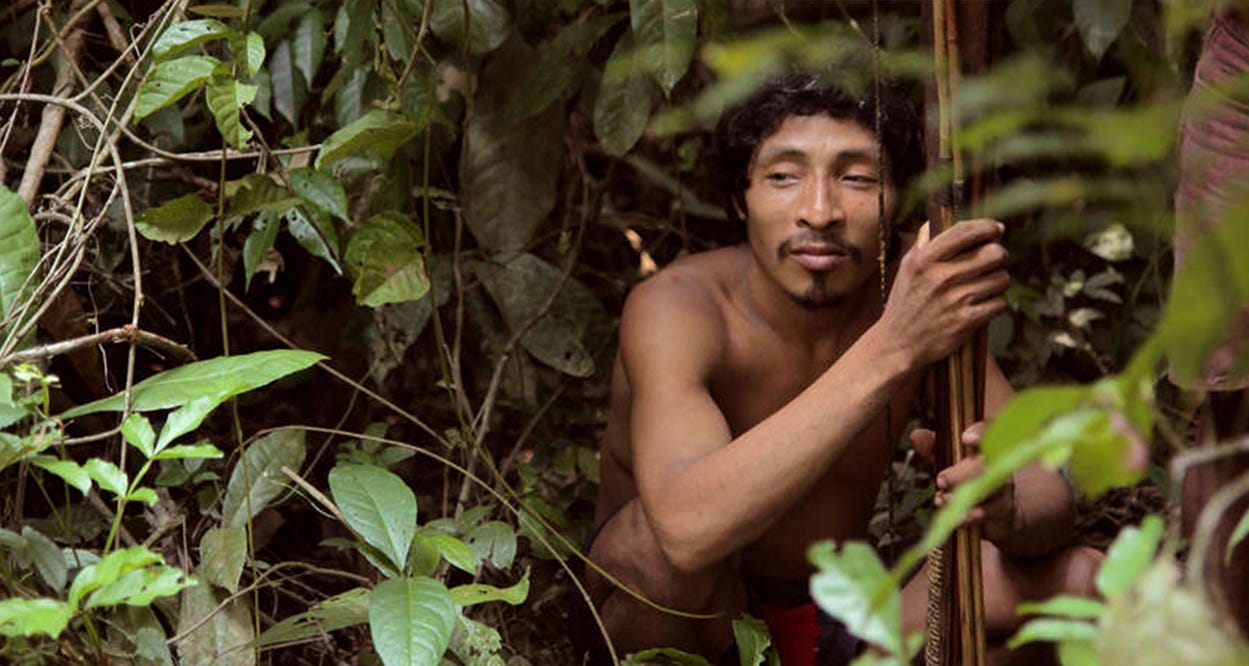
It also reminded me of a fascinating conversation I once had with Dan Everett (an American linguist and author who has worked with the Pirahã people, a remote Brazilian Amazonian tribe).
Our conversation was broad ranging, but Dan’s telling of the Pirahã stepped outside how we commonly consider verbal language; it challenged how we interpret visual language, reinforced how place and community are central to existence, and reminded me of what we can learn from Indigenous peoples.
The following is a fascinating excerpt from that conversation.
Kevin: Many would argue that language preserves culture. Although the Pirahã have recently begun to learn Portuguese, they generally only speak their own language, which I believe is unusual among Amazonian tribes. You’re one of the few people who speak Pirahã fluently. One of the most fascinating aspects about the Pirahã language is how it can be communicated; their language can be spoken, hummed, sung, or whistled. How is it possible to sing and hum a language?
Dan Everett: The reason that it’s easier for the Pirahã to do this is that their language is tonal. The pitches on the vowels, whether the vowel is a high pitch or a low pitch, are very easy to whistle. When you combine that with the syllable structure of the language, and the general intonation and a number of other characteristics that use pitch, and length and loudness, you’re able to whistle an entire phrase. They can follow you fine without context. They can communicate anything by whistling, or humming or these other ways that we can with consonants and vowels.
Amazing! Can you yourself hum, whistle or sing the Pirahã language, or just speak it?
I speak it well, but I don’t do those other things very well. If I do, they laugh. They think it’s funny that I’m doing this. If they start whistling or humming, they can lose me very easily, very quickly.
One of the most fascinating aspects about the Pirahã language is how it can be communicated; their language can be spoken, hummed, sung, or whistled. How is it possible to sing and hum a language?
I believe the Pirahã don’t have any words for colours or numbers, and they don’t have any words for past or future tense. Research from MIT (Massachusetts Institute of Technology) suggests the Pirahã are the only culture in the world without numeracy. Aside from being a fascinating fact, is there a deeper significance to those findings?
Yes. I’ve tried to explain all of this based on a single principle that I’ve called the, Immediacy of Experience Principle. There’s a very long, and involved and technical explanation of how this works. But the simple form of it is that they don’t generalise more than they absolutely have to. Numbers are generalisations. It’s not crucial to generalise like that so they simply don’t. It goes beyond the things they experience.
For example, lets take white. White is an abstraction. Black is an abstraction. We call lots of things white: if you put all of them next to each other, they’re not exactly the same colour.
For the Pirahã, they describe things as they see them. “This is clear.” “This is clean.” “This looks like water.” “This looks like a leaf”—in terms of colour.
In terms of numbers, it’s also an abstraction to say three potatoes versus three fish. In other words, you’ve got this characteristic, “three”, which goes beyond my experience. It applies to a range of possible circumstances they haven’t yet experienced.
That said, they can generalise. They have the word dog, which refers to all dogs. That’s a generalisation. It’s not that they don’t generalise. It’s that they don’t generalise more than communication absolutely requires of them.
It’s pretty efficient, and pretty economical.
Yeah. It’s a very economical language, in that sense and in terms of the range of things they talk about, and the shortness of their sentences. Things are more concrete in some senses.
Of course, spoken language is integral to identity, but how important is visual language, considering the Pirahã have no words for colours? Do they have a particular visual language?
They have gestures, but they don’t represent things in two dimensional space except for stick figures. They don’t do drawings. They rarely do things like diagram maps on the ground. “You go here and I’ll go there”—they don’t represent things that way.
Their spoken language is very important. Their gestures are very important. Everything around them is mapped to an internal map. They not only know the jungle very well, but every part of the jungle has names. You wonder how they give can each other such precise directions to go places when they can’t say: “The third turn at the third path, or turn at the second river you come to.” They don’t say things like that.
But everything: every body of water, every path, all of these things have names. They can tell each other, with great precision, where to be. But it requires that their local environment is almost completely memorised and mapped in everyone’s head.
I picked up a particular phrase from the film [The Grammar of Happiness], which the Pirahã often say: “I almost begin to want that,” which suggests they don’t hold much value for material possessions. There has been, as you say, a threshold-crossing where all of a sudden perhaps material possession, or practical tools and possessions, might actually now be accepted.
Yes, and part of the issue is that the government comes in and gives them these things. Nobody has worked for it, or anything like that, they’re just given all these things. They’re given cookies, they’re given white rice, they’re given fishhooks.
The Pirahã don’t need charity, they’re not poor. People see the way they live, and if they don’t have any kind of ethnographical, ethnological background, they think the Pirahã are poor people.
But the concept of poverty did not even exist among the Pirahã. They had everything they needed, and they were extremely happy—and well off. These things, which have now been given to them, has created addictions. And you can see it in North America, here in the United States, in particular. This is how we acted 100 years ago, and it produced a lot of very negative effects.
Considering the environmental crisis we all face, many argue that it is in our own interest—and in the interest of every living plant and animal—to actively learn and implement aspects of indigenous cultures. For example, the Pirahã have no buildings. I realise this may have changed since the FUNAI [the agency responsible for Brazil’s indigenous tribes] have come in, but generally their culture is to have no buildings. They have no cultivation, or agriculture. They rely totally on nature, and live in complete unison with their surroundings. As you mentioned earlier, they know every species of flora and fauna that surrounds them, and they live entirely in the present—and they appear to be very happy about that fact. Is it realistic for modern society to incorporate some aspects of that way of life? Is it even practical?
It is, but you can’t just do this in a superficial way. You have to really understand these cultures. If they disappear we lose the opportunity to understand them.
But I would say the greatest lesson of the Pirahã, which can be easily learned, is self sufficiency. There are so many lessons. Every single language culture pairing on the face of the earth—and there are over 7,000—has learned to cope with the world and has been very effective. Otherwise, they would be dead.
They’ve solved problems and come up with philosophies, and classifications of nature that are all of value. As these disappear, we lose opportunity to collect information that can be very important for our species.
Information from each one of these pairings has taken centuries to develop, and they’re a far greater resource for our survival as humans than any other thing in nature—I’m sure of it. We need to study them. We need to learn the lessons they have to teach us. And we have lessons for them, as well. We need to help them learn to navigate through these changes. It’s a mutual relationship.